


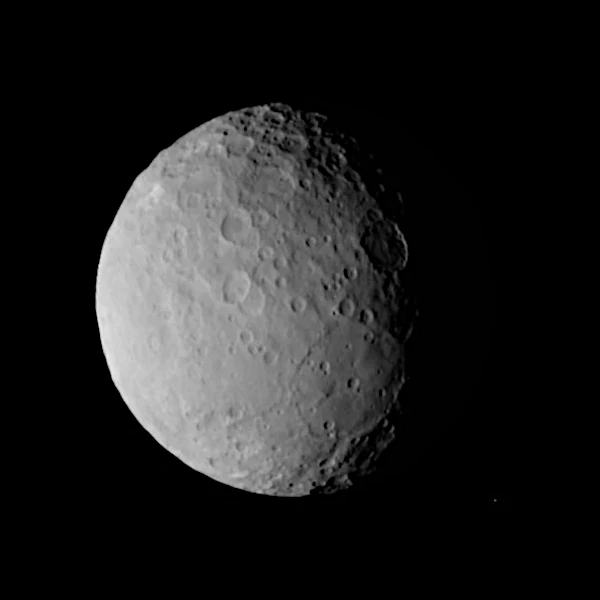
Ceres is the largest object in the main asteroid belt located between Mars and Jupiter. Officially classified as a dwarf planet since 2006 by the International Astronomical Union (IAU), it represents a physical and taxonomic boundary between asteroids and dwarf planets. This duality raises fundamental questions about its physical properties, formation, and evolution.
Ceres has an average diameter of about 940 km, making it the largest object in the asteroid belt. Its mass, estimated at 9.39 × 10²⁰ kg, represents about 30% of the total mass of the main belt. Its average density, about 2.16 g/cm3, indicates a mixed composition of silicate rocks and water ice. This intermediate density is a key physical indicator, revealing that Ceres is not a simple rocky asteroid but contains a significant amount of volatile material.
N.B.:
The main volatile material contained in Ceres is water ice, accompanied by hydrated minerals and probably traces of other volatile compounds such as ammonia. This composition largely explains its intermediate physical properties between a rocky asteroid and an icy dwarf planet.
Gravitational studies and observations from the Dawn mission have shown that Ceres is likely differentiated: a dense rocky core would be surrounded by a mantle of water ice that is partially or completely solid. This process of physical differentiation assumes sufficient internal heat, possibly generated by radioactive decay and gravitational contraction, allowing the separation of materials according to their density.
The IAU defines a dwarf planet as a celestial body that orbits the Sun, has sufficient mass for its gravity to make it adopt a hydrostatic shape (almost spherical), but has not cleared its orbit of other debris. Ceres meets these criteria: its shape is almost spherical (hydrostatic equilibrium shape confirmed by precise measurements), but its orbital region is not very clear, unlike classical planets.
Asteroids, on the other hand, are generally smaller, often irregular, and not differentiated (no distinct internal layers), although the distinction is not absolute. Ceres is therefore at the crossroads of the two categories, which explains its hybrid status.
Due to its physical properties and location, Ceres constitutes a natural laboratory for understanding the processes of planetary formation, particularly the transition between small bodies and planets. The presence of ice water and past or present cryovolcanic activities also highlights the geophysical complexity of this body.
| Characteristic | Ceres | Typical Asteroid | Typical Dwarf Planet |
|---|---|---|---|
| Diameter (km) | ≈ 940 | 10 - 500 (e.g., Vesta ≈ 525 km) | Several hundreds to thousands (Pluto ≈ 2377 km) |
| Density (g/cm3) | 2.16 (indicating ice and rock) | 2.0 - 3.5 (mainly rocky or metallic) | 1.8 - 2.1 (e.g., Pluto 1.85; Eris 2.52) |
| Shape | Almost spherical (hydrostatic equilibrium shape) | Often irregular | Almost spherical |
| Internal differentiation | Presumed (rocky core + icy mantle) | Often undifferentiated | Yes, differentiated |
| Orbital clearance | No (main belt) | No | No (unlike classical planets) |
Source: NASA Solar System Exploration - Ceres, Russell et al. (2015), Science, IAU - Definition of Dwarf Planets 2006.
 Dwarf Planets: The Forgotten Worlds of the Solar System
  Physical Composition of Trans-Neptunian Objects in the Kuiper Belt
 Haumea and its Moons: A Singularity of the Solar System
 The Enigma of the Oort Cloud: Indirect Evidence and Uncertainties
 Sedna: Between the Kuiper Belt and the Oort Cloud
 Quaoar: The Dwarf Planet Defying the Roche Limit with its Rings
 The 40 largest objects in the solar system
 Pluto's Satellites: Strange Companions in the Dwarf Planet's Shadow
 Ceres: Boundary Between Asteroid and Dwarf Planet
 Pluto and its Moons: Charon, Nix, Hydra, Styx, and Kerberos
 Eris: The Dwarf Planet at the Edge of the Solar System
 Gonggong: An Eccentric Witness to Distant Perturbations
  Meteor Showers: Perseids, Leonids, Geminids...
  Interstellar Comets: When the Universe Sends its Messengers
  The Asteroid Bennu: The Building Blocks of Life
  Formation of Asteroids: From Cosmic Dust to Small Rocky Bodies
  The Asteroid Bennu: A Rotating Rubble Pile
  Yarkovsky Effect on Asteroids
  Arrokoth, the
red snowman
Arrokoth, the
red snowman  The Kirkwood Gaps in the Main Asteroid Belt
  What is the asteroid belt?
  The Great Comet of 1577 Shattered the Crystal Spheres
  The Invisible Threat of Asteroids: From Pebbles to Flying Mountains
  Meteorites: Messengers from Space and Witnesses of the Solar System
  Comet Hartley 2: The Icy Heart Scrutinized by Deep Impact
  When Two Asteroids Collide: The Strange Case of P/2010 A2
  2005 YU55: The 400 m Asteroid that Grazed Earth
  Asteroid Apophis: The Perfect Candidate for a Global Impact?
  Vesta: The Colossus of the Asteroid Belt
  From Asteroids to Planets
 2012 and Comet ISON: Between Promise of Brilliance and Disappointment
  Giants of the Asteroid Belt: Classification by Size
  Impact
craters on Earth
Impact
craters on Earth  Online Simulator: Orbits of Asteroids
  Online Simulator: Orbits of Near-Earth Asteroids
  Rosetta has a date with a comet
  Near-Earth Asteroids: An Underestimated Threat to Our Planet?
  Asteroid 2009 DD45: A Reminder of Planetary Vulnerability to Asteroids
  Strange Resemblance Between Comet Hartley 2 and Asteroid Itokawa
  Earth's Trojan Asteroids: Companions Sharing Our Orbit
  Turin Scale: A Classification of Impact Risks
  The Nice Model: Towards an Explanation of the Late Heavy Bombardment
  NEO Monitoring: The Case of Asteroid 2012 LZ1
  Comet Lemmon (C/2012 F6): The Southern Hemisphere's Green Visitor
  Asteroid 2012 DA14 passed on February 15, 2013
  Near-Earth Asteroid 2012 BX34: A Record Close Approach to Our Planet
  Didymos and Dimorphos: The First Asteroid Moon Moved by Humanity
  Chariklo and its rings: a surprising centaur asteroid
  Rosetta and Philae: A Feat 500 Million Kilometers from Earth
  The Passage of Comets: Eccentric Orbits at the Heart of the Solar System
  Vesta and its Curiosities: The Enigma of the Torn South Pole
  Meeting the Asteroids: The Main Belt
  Orbits of Near-Earth Asteroids: When Asteroids Brush Past Earth
  Wandering
comets
Wandering
comets  Asteroid Pallas: A Giant of the Main Belt
  Asteroid Juno: an unknown giant of the solar system
  Ganymed (1036): Near-Earth and Mars-crosser
  Earth's quasi-satellite: 2016 HO3