


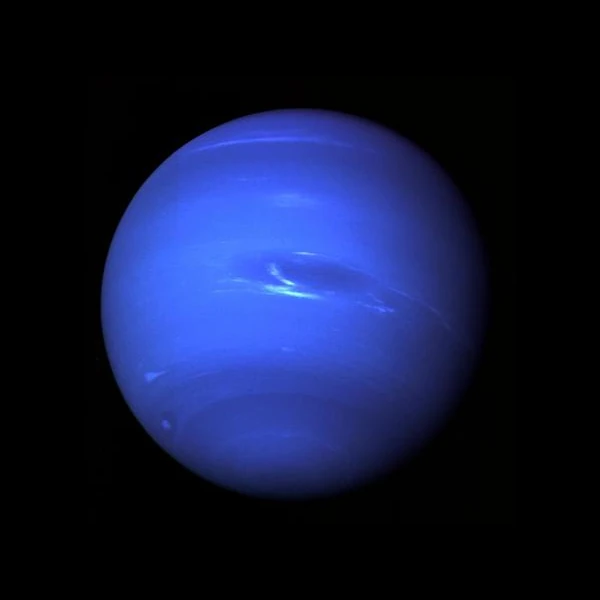
Neptune is the eighth planet of the Solar System and the outermost of the ice giants. It has a deep blue hue resulting from the interaction of its atmosphere with sunlight. The atmosphere is mainly composed of hydrogen and helium, with about 2% methane (CH₄). Methane strongly absorbs red and orange wavelengths (~600–750 nm) of sunlight, while shorter wavelengths in the blue and green (~450–550 nm) are scattered or reflected by the upper layers of the atmosphere. This selective scattering produces the visual effect of a deep blue, similar to Rayleigh scattering that makes Earth's sky blue.
N.B.:
Rayleigh scattering is a physical phenomenon in which small particles, comparable to or smaller than the wavelength of light, preferentially scatter short wavelengths (blue and green) rather than long (red).
On Neptune, this scattering contributes to the intense blue color observed on the planet, amplified by the absorption of red wavelengths by atmospheric methane.
Neptune has an average radius of 24,622 km (3.86 times Earth's) and a mass of 1.024 × 1026 kg (17 times Earth's mass). Its average density is 1.638 g/cm3 (Earth 5.51 g/cm3), indicating a composition mostly of ices and rocks, with a likely rocky core and a mantle of water, ammonia, and methane in supercritical fluid form.
Neptune's atmosphere is primarily composed of hydrogen and helium, with about 2% methane. Supersonic winds exceeding 2,000 km/h have been measured. The planet exhibits spectacular atmospheric storms, including the Great Dark Spot observed by Voyager 2.
Neptune currently has 14 confirmed moons, each with unique characteristics. The largest, Triton, is notable for its retrograde orbit, suggesting it was captured by Neptune rather than forming with the planet. Triton is also geologically active, with cryovolcanoes emitting jets of ice and gas, and its surface shows varied terrains from smooth plains to fractured regions, revealing a young and dynamic relief.
Other moons, such as Nereid with its highly eccentric orbit, and smaller satellites like Proteus and Larissa, provide insights into the complex gravitational history of the Neptune system. These bodies are mainly composed of water ice and rock, with low densities similar to Triton.
Neptune also has narrow and dark rings, primarily made of dust and icy particles, first detected from Earth and confirmed by space missions such as Voyager 2. These rings have evocative names (Galle, Le Verrier, Lassell, Arago) and display narrow, segmented structures, probably maintained by small "shepherd" moons. The low albedo of these rings, less than 0.05, makes them hard to observe from Earth.
The combined study of Neptune's moons and rings helps to understand gravitational interactions, capture processes, and the dynamics of outer planetary systems. Triton, in particular, is a natural laboratory for studying cryogeology and planetary interactions far from the Sun.
Neptune was discovered in 1846 through the mathematical calculations of Urbain Le Verrier (1811-1877) and John Couch Adams (1819-1892). The only mission to have flown by Neptune remains the Voyager 2 probe in 1989.
| Property | Neptune | Earth |
|---|---|---|
| Average radius | 24,622 km | 6,371 km |
| Mass | 1.024 × 1026 kg | 5.972 × 1024 kg |
| Average density | 1.638 g/cm3 | 5.513 g/cm3 |
| Orbital period | 164.8 Earth years | 1 year |
| Maximum wind speed | 2,100 km/h | 400 km/h (extreme hurricanes) |
| Number of moons | 14 | 1 |
The Neptune system, although distant and difficult to observe from Earth, reveals a fascinating complexity. Its narrow and dark rings, such as the Faint Ring, made of dust and icy particles, testify to subtle gravitational dynamics. These fragile and discreet rings are often segmented and maintained by the influence of small, invisible shepherd moons. Some portions of the rings are thicker or denser, others almost empty, giving the impression of "broken" rings or multiple arcs.
| Ring Name | Average Distance from Neptune (km) | Approx. Width (km) | Main Features |
|---|---|---|---|
| Galle | 41,900 | ~2,000 | Narrow, dark, low density |
| Lassell | 42,200 | ~1,000 | Weak and narrow ring |
| Le Verrier | 53,200 | ~5,000 | Main ring, contains multiple bright arcs |
| Arago | 57,200 | ~1,000 | Thin and dark ring |
| Adams (Faint Ring) | 63,930 | ~50–100 | Segmented ring with arcs named Liberté, Égalité, Fraternité, Courage, Égalité 2 |
Moving away from the rings, we discover Neptune's multiple satellites, each contributing a piece to the puzzle of the planet's history. Among them, Triton stands out for its size, retrograde orbit, and active cryovolcanic geology. This moon, probably captured by Neptune, shows varied terrains, from smooth plains to deep fissures, and emits jets of ice and gas illustrating the persistent internal activity of this icy world.
| Moon Name | Radius (km) | Average Distance from Neptune (km) | Main Characteristics | Mythological Character |
|---|---|---|---|---|
| Triton | 1,353 | 354,800 | Largest moon, retrograde orbit, active cryovolcanism, likely a captured moon | Son of Poseidon (Neptune) and Amphitrite, sea god with a fish tail |
| Nereid | 170 | 5,513,400 | Highly eccentric orbit, small irregular moon | Sea nymph, daughter of Nereus and Doris, servant of Poseidon |
| Proteus | 210 | 117,700 | Second largest moon after Triton, dark and irregular surface | Old man of the sea, capable of changing shape, marine prophet |
| Larissa | 97 | 73,600 | Inner moon, almost circular orbit, rocky and dark | Thessalian princess, lover of Poseidon |
| Despina | 75 | 52,500 | Small inner moon, close orbit to Neptune | Daughter of Poseidon and Demeter, goddess of hidden nature |
| Galatea | 87 | 61,950 | Moon guarding the Le Verrier ring, small and rocky | Nereid loved by the Cyclops Polyphemus, symbol of marine beauty |
 ETNO, Relics of the Primordial Chaos: In Pursuit of the Ghost of Planet Nine
  Phantom Super-Earths: The Lost Worlds of the Solar System
  Perihelion and Aphelion: The Apsides in the Solar System
  Winds of the solar system and giant planets
 3D Simulator: Revolutions of the Planets
 Mercury: The Planet with Two Faces
 Venus: Earth's Infernal Twin
 Earth, the Blue Planet: A Fragile Jewel in the Universe
 Mars: The Conquests and First Human Steps on the Red Planet
 Jupiter: A Failed Star at the Heart of Our System
 Saturn: The Harmony of Orbital Resonances
 Uranus: The Planet Tipped on the Horizon of the Solar System
 Neptune: The Blue Giant of the Solar System
 Roche limit
 Remarkable characteristics of the planet Mercury
 Remarkable characteristics of the planet Venus
 Remarkable features of planet Earth
 Remarkable characteristics of the planet Mars
 Remarkable characteristics of the planet Jupiter
 Remarkable characteristics of the planet Saturn
 Remarkable characteristics of the planet Uranus
 Remarkable characteristics of the planet Neptune
 Characteristics of Planets: What Makes Them Unique
 Venus, Veiled Planet: A Puzzle in our Solar System
 Live on Mars
 The seven wonders of the World
 Planet 9: The Enigma That Challenges Planetary Models
 Axial Tilt of Planets: An Unstable Dance Through the Ages
 Comparative sizes of planets and stars
 The Journey of the Planets Along the Ecliptic: A Cosmic Choreography
 Declination and right ascension
 Saturn's Rings: A Ring System in Jeopardy