


Ecuador, located on the Pacific Ring of Fire, is a country marked by intense volcanic activity. It is home to some of the most impressive volcanoes in South America, such as Cotopaxi, one of the highest active volcanoes in the world, and Tungurahua, known for its frequent eruptions. These giants of fire, often snow-covered, shape the Andean landscapes and influence the lives of local populations, both through the risks they pose and the fertile soils they generate. Ecuadorian authorities closely monitor these colossi, particularly through the Geophysical Institute, to prevent disasters and protect neighboring communities. Volcanic activity in Ecuador thus remains a phenomenon that is both fascinating and feared, testifying to the power of nature.
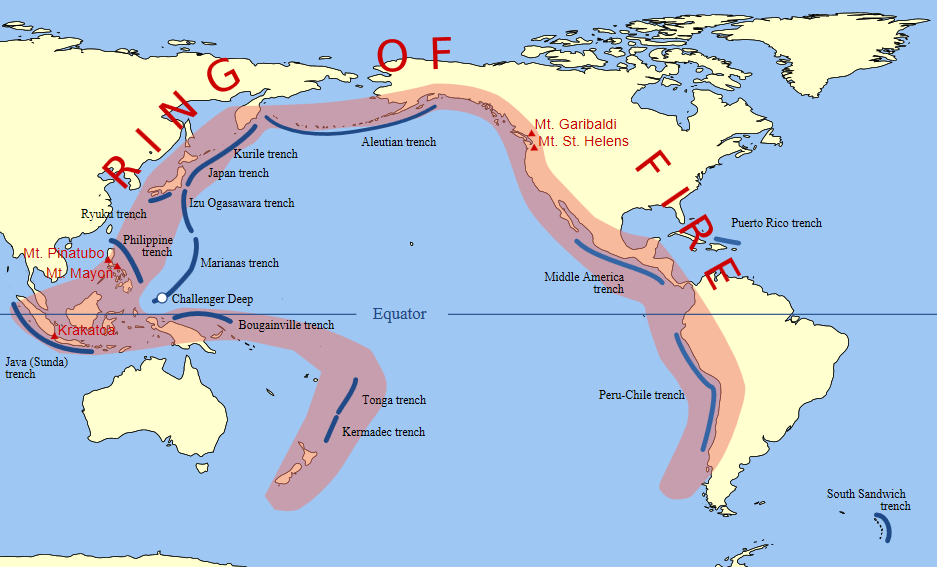
All these volcanoes are part of the Pacific Ring of Fire, an immense zone 40,000 km long, which concentrates about 90% of the world's earthquakes and 75% of active volcanoes. In Ecuador, this activity results from the subduction of the Nazca Plate under the South American Plate. This geological dynamic shapes the Andean landscapes but also exposes the country to major natural risks.
| Name | Altitude (m) | Last Eruption | Ring of Fire | Status |
|---|---|---|---|---|
| Chimborazo | 6 263 | 550 AD ± 150 years | Yes | Inactive |
| Cotopaxi | 5 897 | 2022 | Yes | Active |
| Cayambe | 5 790 | 1786 | Yes | Potentially active |
| Antisana | 5 753 | 1802 | Yes | Potentially active |
| Altar | 5 319 | 1460 | Yes | Inactive |
| Iliniza Norte | 5 126 | Pleistocene | Yes | Extinct |
| Tungurahua | 5 023 | 2018 | Yes | Active |
| Sangay | 5 230 | 2023 (ongoing) | Yes | Active |

Chimborazo, a majestic giant of the Andes, is the highest point in Ecuador with an altitude of 6,263 meters. Although considered extinct (its last eruption dates back about 1,500 years), it remains a national symbol. Its most fascinating feature is its geographical position: due to the equatorial bulge, its summit is technically the point furthest from the center of the Earth. Its immense ice cap, now receding, feeds several rivers in the surrounding provinces.
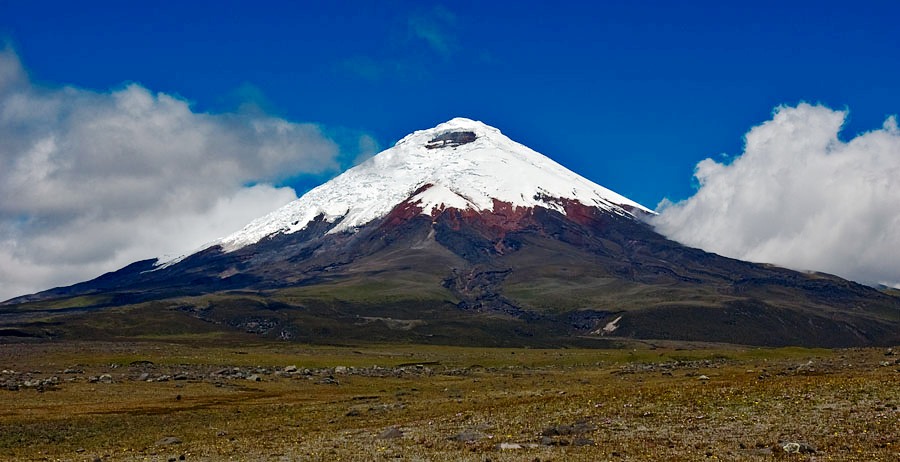
Cotopaxi, with its perfectly symmetrical cone covered by a glacier, is one of the most active volcanoes in the world. Classified among the Decade Volcanoes, it is under constant surveillance. Its historical eruptions have been devastating, such as the one in 1877. After a period of calm, Cotopaxi showed signs of increased activity in 2015, with a new eruptive phase in 2022. Its proximity to Quito makes it a major risk but also a tourist attraction.

Cayambe is a unique volcano in the world, as it is crossed by the equatorial line. Although considered potentially active, its last confirmed eruption dates back to the 18th century. It houses an extensive glacier, the third largest in Ecuador. Fumaroles are regularly observed near its summit. Cayambe is also a sacred site for indigenous communities.

Sangay, located in the eponymous national park, is one of the most active volcanoes on the planet, in almost continuous eruption since 1934. Its isolation makes it a little-visited site, but its frequent explosions offer an impressive spectacle. Listed as a UNESCO World Heritage site, Sangay is a natural laboratory for the study of volcanism.
 Overview of European Volcanoes: From Etna to Vesuvius
  Overview of African Volcanoes: From Kilimanjaro to Nyiragongo
  Overview of North American Volcanoes: From Mount Saint Helens to Popocatépetl
  Overview of South American Volcanoes: From Aconcagua to Cotopaxi
  Overview of Asian Volcanoes: From Fuji to Krakatoa
  Overview of Oceania's Volcanoes: From Indonesia to New Zealand
  Global Overview of Volcanoes: A World Tour of Fire Giants
  The Toba Super Eruption: Decades of Climatic Chaos
  Mauna Loa is the largest volcano in the world!
  Earth's Great Volcanoes: Red Fury, Gray Silence
  Volcanoes of Kamchatka: The Realm of Icy Volcanoes
  The Titans of Fire: Origin, Power, and Risks of Supervolcanoes
  Active Volcanoes of Colombia: Between Natural Beauty and Eruptive Risks
  New Zealand's Volcanoes: A Natural Laboratory for Plate Tectonics
 Volcanoes and the Origin of Life: When Fire and Water Spark Chemistry
  Underwater Eruptions and the Emergence of New Lands
  Volcanoes of Ecuador: Giants of Fire
  Catastrophe of a Super Eruption
  The Largest Calderas in the World: Earth's Scars
  Supervolcanoes
are invisible!
Supervolcanoes
are invisible!  The Nevado del Ruiz volcano
  The Phlegraean
Fields
The Phlegraean
Fields  The Yellowstone
Supervolcano
The Yellowstone
Supervolcano  The spectacular
caldera of Lake Taupo
The spectacular
caldera of Lake Taupo  Chimborazo: The Highest Peak on the Planet!